1. Introduction: The Billion-Dollar Question
For nearly a decade, the Unified Payments Interface (UPI) has been the heartbeat of India’s digital transformation. From the roadside tea stall to the urban high-street, the "scan and pay" chime has become the definitive soundtrack of our economy. However, the recent passage of the Taxation and Other Laws (Amendment) Bill, 2026 in the Lok Sabha has triggered a wave of digital anxiety. As rumors of "end-of-the-free-era" circulate on social media, many are left wondering if the digital utility we’ve come to rely on is about to become a luxury. The short answer is a reassuring "no"—but the long answer is where the strategic shift lies. While the zero-cost experience remains untouched for the average consumer, the architecture supporting billions of transactions is undergoing a massive, necessary pivot. As UPI evolves from a government-subsidized experiment into a global giant processing trillions, we are finally addressing how to pay the bills for a system that is, quite literally, too big to fail.
2. The ₹10,000 Crore "Hidden" Bill (Sustainability vs. Zero Fees)
While users enjoy a frictionless, free service, the plumbing beneath the surface—comprising cybersecurity, fraud prevention, server upgrades, and compliance—carries a staggering price tag. According to PwC, the industry faces an annual operational loss of approximately ₹10,000–₹12,000 crore due to the Zero Merchant Discount Rate (MDR) model. To put this in perspective, imagine running a national railway network where almost nobody pays for a ticket. To date, the gap has been plugged by a government subsidy, which was recently increased to ₹2,000 crore in the 2026 Union Budget. However, the industry reality is sobering: current subsidies cover a mere 11% of the total costs incurred by banks and payment service providers (PSPs). This "subsidy gap" is no longer just a boardroom complaint; it’s a threat to the innovation and security required as volumes hit staggering peaks—over 2,366 crore transactions worth ₹29.9 lakh crore in July 2026 alone.
"A self-sustaining revenue model is required to ensure that UPI remains robust, inclusive, and future-ready. Reliance on subsidies alone is not viable for the next wave of growth. "—Payments Council of India (PCI) Statement
3. The "Large Merchant" Threshold: Who Actually Pays?
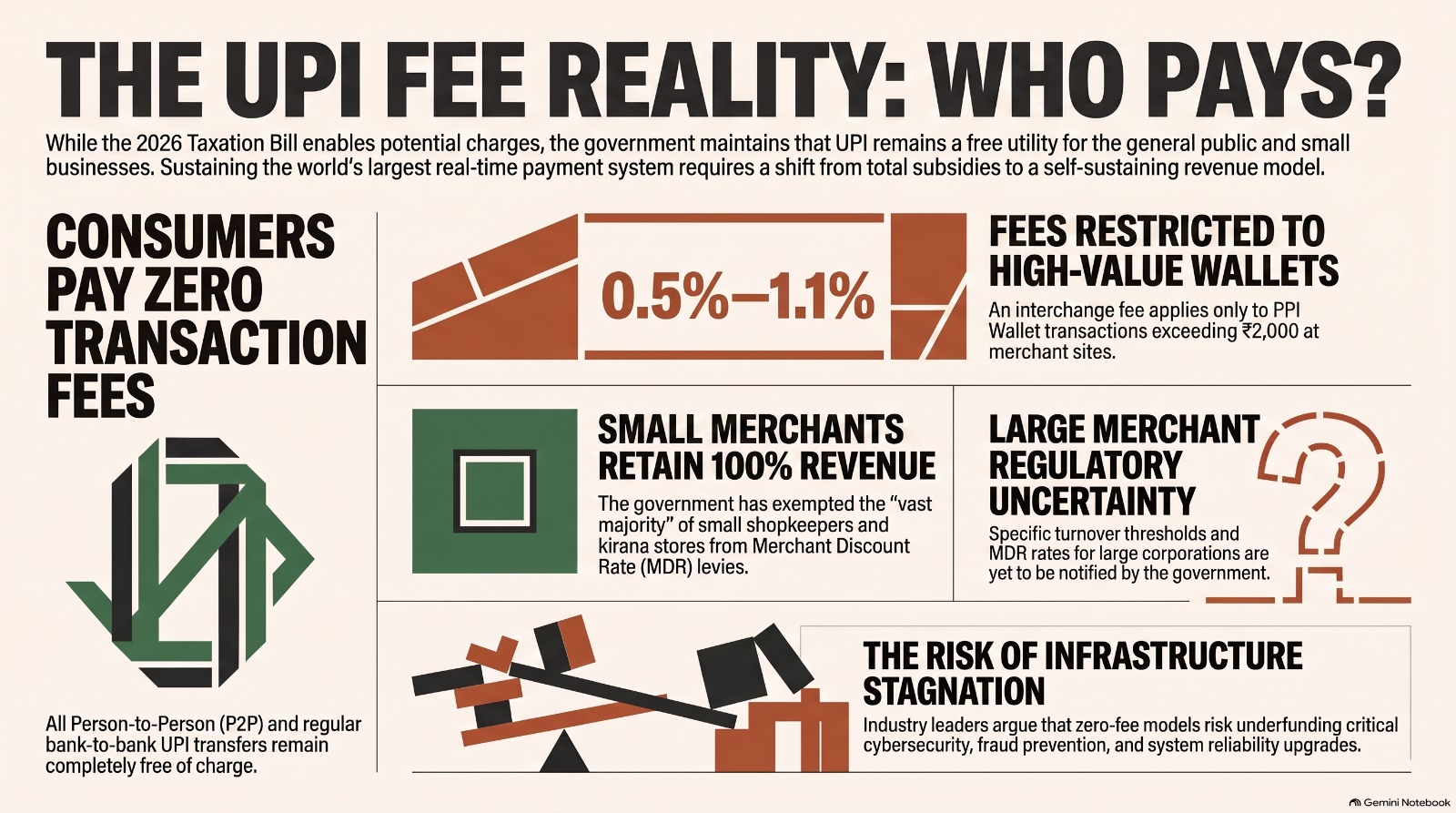
The most vital reality of the 2026 legislative framework is that charges are coming, but they are surgically targeted. The government is focusing on "Large Merchants"—specifically those with an annual turnover exceeding ₹50 crore, as defined under the amended Section 269SU of the Income-tax Act. The proposed model introduces a 25 basis points (bps) MDR for high-volume commercial entities like Amazon, Flipkart, Swiggy, and Zomato. There is a layer of geopolitical pressure here as well; reports from the US Trade Representative (USTR) have previously critiqued UPI’s zero-fee structure for creating a "non-level playing field" for American platforms like Visa and Mastercard. By introducing a nominal fee for Big Tech and large retail, India is effectively professionalizing the ecosystem. Crucially, the law mandates that large merchants cannot pass these costs on to consumers—it is a cost of doing business for the giants, not a tax on your morning coffee.
4. The Magic Number: The ₹2,000 Dividing Line
The strategy to protect the "Digital India" dream hinges on a "low-value, high-volume" protection plan. The vast majority of our daily transactions fall under a specific threshold, and the intent is to keep them entirely free. The "magic number" remains ₹2,000. Data reveals a fascinating skew: currently, only 4% of Person-to-Merchant (P2M) transactions exceed ₹2,000. However, those few transactions represent two-thirds of the total value processed by the network. By monetizing only this top-tier 4% of commercial traffic, the government generates the revenue needed to secure the network while ensuring that the millions of small-ticket payments that drive the informal economy remain unburdened.
5. The "Kirana" Immunity: Protecting the Neighborhood Shop
For the small shopkeeper, the 2026 amendment isn't a threat; it’s a shield. In a world of razor-thin margins, even a 0.1% fee can mean the difference between a profit and a loss. The policy explicitly ensures "Zero MDR" for the local kirana store, keeping UPI as accessible to the vegetable vendor as it is to the luxury boutique.
| Transaction Type | Proposed Status | Who Bears the Cost? |
|---|---|---|
| Consumers (You & Me) | FREE | No Change |
| Person-to-Person (P2P) | FREE | No Change |
| Small Merchants/Kirana | FREE | Zero MDR Protected |
| Transactions < ₹2,000 | FREE | No Change |
| Large Merchants (>₹50Cr Turnover) | Nominal MDR (25 bps) | Large Businesses (Cannot pass to user) |
6. The Rural Reality Check: 80% is Still "Offline"
It’s easy to live in an urban bubble and assume digital payments have conquered the map. But the data tells a different story. Despite our progress, 80% of rural India and 35% of urban India have yet to adopt digital payments. Furthermore, only about 27% of the population meets the minimum threshold for financial literacy. The shift toward a revenue-driven model is, counter-intuitively, about reaching these very people. Expanding into Tier 3 and 4 cities requires massive investments in physical infrastructure and digital literacy. Without a sustainable model that allows fintechs to reinvest, the "next wave" of inclusion would stall, leaving millions behind.
7. Global Context: India’s Unique "Middle Path"
India is pioneering a unique middle path between global extremes. In the United States, the market is purely driven by high fees (often 2–3% MDR). Conversely, India’s initial Socialist Zero-Fee model was excellent for adoption but poor for long-term sustainability. By looking at Brazil’s Pix—which charges a nominal fee to PSPs to recover costs—and Europe’s PSD2 (which prohibits surcharges), India is crafting a hybrid. We are moving toward a system where the "market" pays for the "social good. " This ensures that UPI, which is now live in 11 countries, remains a global benchmark that is both inclusive and economically viable.
8. Conclusion: Beyond the Subsidy
UPI is more than just a payment app; it is a national achievement. But even the best innovations must evolve to survive. The 2026 shift is not about the end of "free"; it is about the end of "fragile. " By moving away from a total reliance on government handouts, we are ensuring that the digital infrastructure of our future is built on bedrock, not sand. As we move toward this self-sustaining future, a final thought remains for us all: As UPI matures into a global giant, how will we continue to balance the convenience we love with the real costs of keeping our digital lives secure? The answer, it seems, lies in a system where the giants fund the progress that keeps the smallest users protected.