What happened
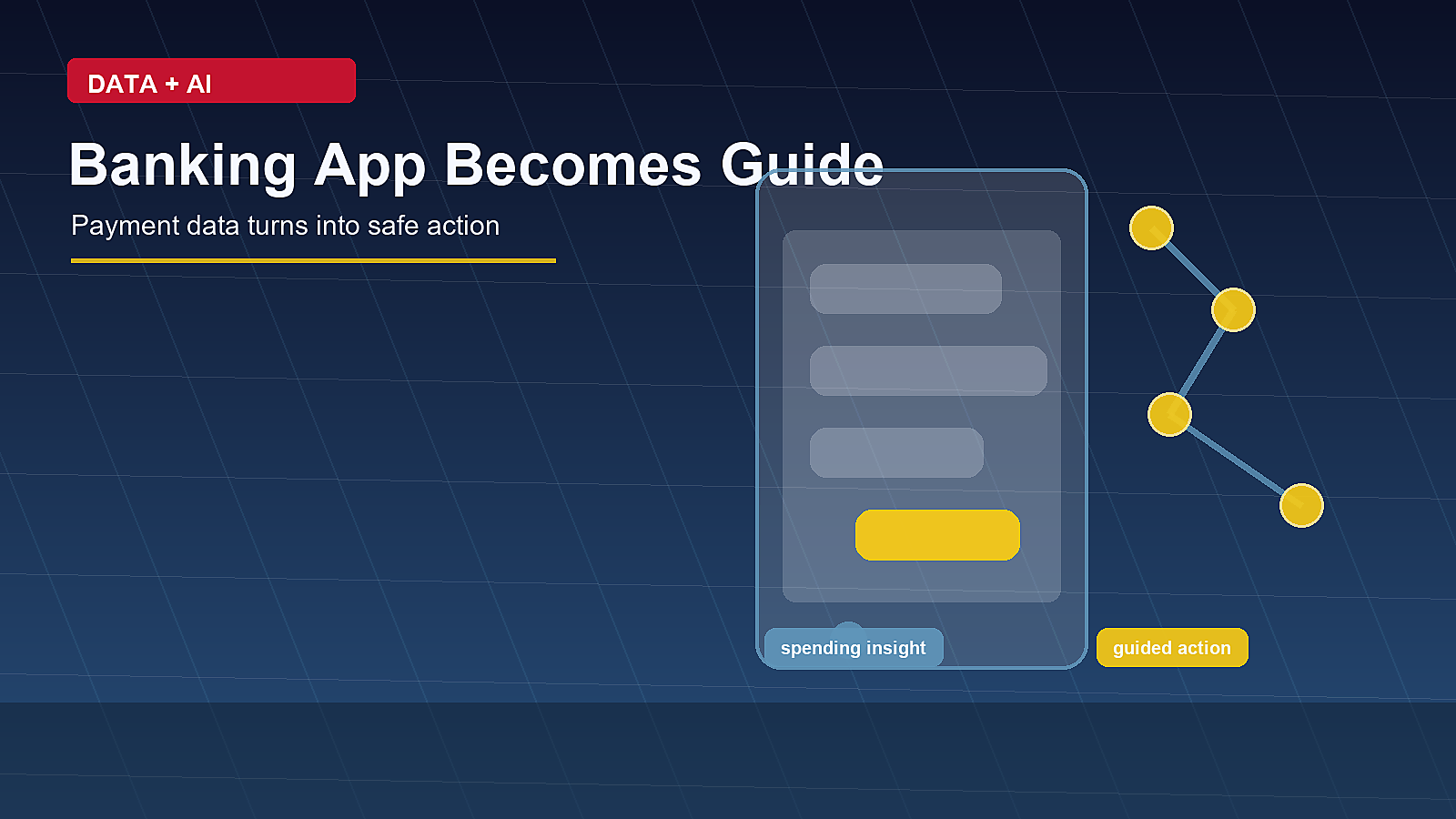
Visa introduced AI Financial Assistant in July 2026 as a value-added service for financial institutions. The product is designed to bring conversational financial guidance into the banking apps consumers already use, with proactive spending insights, natural-language questions and guided actions such as card controls or alerts. Visa said U.S. pilots are planned for August 2026, with broader rollout to follow.
The announcement reflects a wider shift in banking: payment data is becoming the raw material for personalized guidance. Consumers increasingly expect apps to explain spending patterns, subscriptions, budgets and financial choices without forcing them to search through static menus. Banks have the account relationship and data context, but many need packaged AI capabilities to turn that context into useful experiences quickly.
Why this matters
Banks have historically treated mobile apps as service channels: check balance, view transaction, pay bill, lock card. AI changes the interface from menu navigation to conversation. A customer may ask why spending changed, what subscriptions increased, whether a payment looks unusual or how to set a travel alert. If the bank app can answer and act, engagement shifts from passive recordkeeping to active guidance.
Visa's position is notable because networks sit on broad transaction intelligence, issuer relationships and risk infrastructure. A bank-specific assistant can use the institution's own customer data while being informed by wider payment patterns and governance standards. That combination may help banks compete with consumer AI tools that can offer advice but cannot safely act inside a regulated financial account.
Trust advantage for banks
Consumers may experiment with general AI tools for financial questions, but they still tend to trust banks with sensitive account data. That trust creates an opening. A bank-branded AI assistant can provide guidance in an environment where authentication, permissions, audit logging and compliance are already part of the operating model.
The challenge is accuracy and scope. A banking assistant must avoid overpromising, giving inappropriate advice or making changes without clear consent. The most useful version will be practical rather than theatrical: explain spending, identify anomalies, suggest controls, guide users to product information and help them complete simple actions safely.
Payments data as a product layer
Payment data is uniquely useful because it captures real behavior. Salary deposits, recurring subscriptions, travel purchases, food delivery, fuel, bill payments and card-not-present activity all reveal financial patterns. When organized responsibly, those signals can power alerts, savings prompts, merchant insights, subscription management and fraud warnings.
For issuers, that turns card and account activity into a retention tool. A customer who receives timely, useful guidance inside the bank app has fewer reasons to rely only on third-party budgeting tools. But banks must keep explanations transparent. Users should understand whether an insight is based on their own data, network benchmarks, merchant categories or bank-provided product information.
Operator implications
Financial institutions evaluating AI assistants should start with governance. What data is used? What actions can the assistant take? Which responses require disclaimers or human escalation? How are errors corrected? How are prompts monitored for security and fairness? AI in banking is not simply a front-end feature; it is a controlled operating environment.
Banks should also connect the assistant to real workflows. A spending insight that cannot lead to an alert, card control, subscription review or support path may feel decorative. The best AI assistant will combine explanation with safe action. That is where payments data becomes operational.
Strategic read
Visa's AI Financial Assistant is another sign that payments companies are moving deeper into bank engagement software. The transaction is no longer the end of the relationship. It becomes input for insight, security and action.
For NXBits readers, the key takeaway is that AI in payments will not only appear at checkout. It will appear inside banking apps, risk workflows, merchant dashboards and customer-service journeys. The winners will be firms that pair useful personalization with strong permissioning and trust.
Roadmap for payment teams
The practical value of this development depends on whether operators turn it into a roadmap. For data insights teams, the first step is to identify the exact workflow affected by the news, not just the technology named in the announcement. A useful internal memo should state which customer journey changes, which back-office process changes, which teams need to approve the change and which metric will prove that the change improved the payment operation.
The second step is to separate rail capability from operating readiness. A new rail, API, rule, platform or data layer may be available, but that does not mean a bank, PSP, merchant or fintech can safely expose it to customers. Readiness includes support scripts, reconciliation rules, exception queues, fraud review paths, treasury sign-off, product documentation and customer-facing language that avoids overpromising.
Data teams should decide which payment signals are allowed to drive customer guidance, which models need review, how insights are explained and what actions a user can safely take from the insight.
Agentic commerce teams should define user permissioning, spending limits, merchant categories, approval triggers, audit trails and revocation paths before allowing software agents to initiate transactions.
Payment operations teams should translate the news into live workflow changes rather than treating it as a market headline. Reach, reliability, controls and reconciliation should all be measured.
What to monitor next
Over the next quarter, the most important signal will be whether Visa and the surrounding ecosystem move from announcement to repeatable implementation. Payment teams should look for pilot participants, geographic expansion, pricing details, certification requirements, uptime data, case studies and evidence that customers or merchants can use the capability without manual workarounds.
A second signal is how competitors respond. If visa's ai financial assistant pushes banks toward in-app financial guidance becomes part of a broader market pattern, similar capabilities will appear in processor roadmaps, bank product updates, gateway integrations, risk vendor tools or regulator consultations. That competitive response usually tells operators whether the news is a one-off feature or the beginning of a new baseline expectation.
The final signal is operational friction. Payments innovation succeeds when it reduces hidden work: fewer failed transactions, fewer support tickets, cleaner ledger entries, better fraud outcomes, faster onboarding, stronger customer confidence or lower trapped liquidity. If the new capability creates another dashboard, another manual exception queue or another ambiguous settlement process, adoption will slow even if the headline sounds advanced.